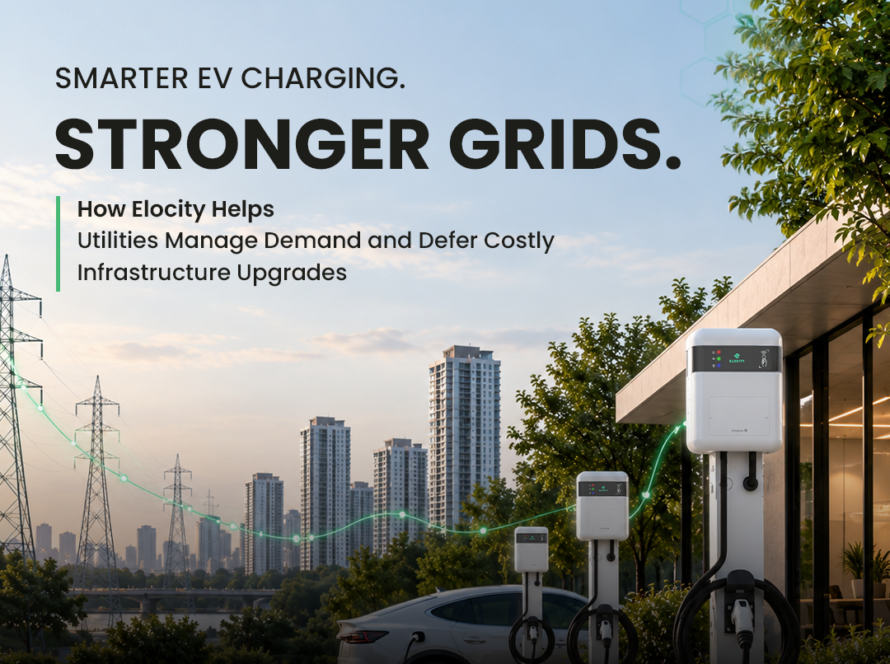
HIEV: Nano is Elocity’s intelligent nano-grid controller: a hardware and software system designed to connect solar photovoltaic (PV) generation, on-site battery energy storage systems (BESS), and EV charging within one coordinated energy-management layer. Instead of allowing three separate systems to operate independently, HIEV: Nano is designed to coordinate them in real time – using solar surplus for EV charging, dispatching stored energy to control demand peaks, and responding to utility signals for managed charging and future bidirectional-energy programs.
Planned for mid-2027, HIEV: Nano will extend Elocity’s HIEV platform from charge-point management into site-level energy orchestration. The result is a clearer path for buildings, fleets, developers, and utilities that want to integrate charging with renewable generation and storage without creating another isolated system.
Why Siloed Energy Systems Fall Short
Most sites with solar PV, battery storage, and EV charging still operate them as separate systems, often with different vendors, dashboards, and control logic — the coordination gap a nano-grid controller is designed to close. Without real-time coordination, the site can miss savings, underuse renewable energy, and lose opportunities to support the grid.
- A solar inverter may export surplus energy at a low rate while EV chargers draw electricity from the grid at the same time.
- A battery may follow a fixed schedule that does not respond to real-time EV demand, solar generation, or electricity prices.
- EV chargers can create demand peaks that a coordinated battery could help absorb.
- Demand-response participation is harder when connected assets cannot respond through a common control layer.
HIEV: Nano is designed to bring these assets under one local intelligence layer connected to HIEV CPMS, providing coordinated control, centralized visibility, and one point of accountability.
What Is a Nano-Grid?
A nano-grid is a small, locally managed energy system that combines distributed energy resources – commonly solar PV, battery storage, and controllable loads such as EV charging – into one coordinated unit. It typically operates at a building or individual-site level and exchanges energy with the wider electricity grid.
A microgrid is generally larger and may be designed to operate independently from the main grid. A smart charger, by contrast, manages only the EV charging session. A nano-grid controller manages the relationship among the building, solar generation, battery storage, EV chargers, and the grid at the same time.
HIEV: Nano is designed to provide this site-level coordination as a nano-grid controller, using HIEV CPMS for cloud-based monitoring, optimization, reporting, and utility communication.
HIEV: Nano Capabilities
| Capability | What it does | Primary benefit | Availability |
| V1G smart charging | Controls charging rate and timing using electricity prices, solar output, grid signals, and building demand. | Lower charging cost and controlled site demand. | Planned at launch. |
| V2H / V2B | Allows a compatible EV to supply a home or building during outages or peak periods. | Backup-power resilience and peak reduction. | Planned; requires compatible vehicle and bidirectional hardware. |
| V2G | Enables compatible EVs to export stored energy to the grid for eligible programs. | Potential grid-service value and demand-response participation. | Planned; availability depends on vehicle, charger, interconnection, and utility-program rules. |
| Solar coordination | Adjusts charging to use on-site solar surplus and reduce grid imports. | Higher renewable self-consumption and lower charging-energy cost. | Planned at launch. |
| BESS integration | Coordinates battery charging and discharge with solar, EV demand, and building load. | Peak shaving, energy arbitrage, and resilience. | Planned; integration varies by storage system. |
| Grid-supportive charging | Curtails or shifts charging in response to utility or site signals. | Grid flexibility without requiring full bidirectional charging. | Planned; utility integration required for managed programs. |
| Demand management | Coordinates charging, storage, and solar so the combined load stays within a configured site limit. | Lower or avoided demand peaks and infrastructure upgrades. | Planned at launch. |
Technical Foundation
For charger communication, HIEV: Nano is designed around OCPP, supporting interoperable connections with compatible charging hardware. Solar and storage integration may use standards and interfaces such as Modbus, SunSpec, or manufacturer APIs, depending on the connected equipment.
Bidirectional communication is designed to align with ISO 15118-20:2022, which defines communication requirements that support bidirectional power transfer between compatible EVs and charging equipment.
For energy-based EV charging transactions in Canada, sites should also consider Measurement Canada requirements for EV charging stations.
HIEV: Nano vs. a Siloed Approach
| Area | Typical siloed approach | HIEV: Nano approach |
| Solar PV | Surplus may be exported while chargers draw grid power. | Solar surplus can be directed to charging when conditions allow. |
| Battery dispatch | Battery follows its own schedule with limited awareness of charging demand. | Battery dispatch can respond to charging, solar, price, and building-load data. |
| EV load management | Charging is managed separately from solar and storage. | Charging is coordinated with other site assets in real time. |
| Demand management | Each system optimizes independently, so combined demand may still peak. | One control layer manages the site’s combined demand against a configured limit. |
| Demand response | Assets may respond inconsistently or not at all. | Connected assets can be coordinated through a common control strategy. |
| Operations | Multiple dashboards, vendors, and service relationships. | Centralized visibility through HIEV CPMS and a clearer support model. |
| Reporting | Data may require manual aggregation. | Consolidated energy and charging data can simplify operational and sustainability reporting. |
Who HIEV: Nano Is For
HIEV: Nano is intended for sites that operate, or plan to operate, at least two of these assets — solar PV, battery storage, and EV charging — coordinated through a common nano-grid controller.
| Audience | Challenge | Potential outcome |
| Condo or strata property manager | Solar and charging are managed separately; residents need scalable, fairly managed charging. | Coordinate solar with managed charging and improve site-level visibility. |
| Homeowner with EV and solar | Daytime solar surplus and evening charging are not coordinated. | Use more on-site solar and enable future V2H resilience where compatible. |
| Fleet depot | Simultaneous charging creates demand peaks while rooftop solar or storage is underused. | Coordinate schedules, site demand, solar, and storage around operational needs. |
| Commercial building owner | Solar, BESS, and charging operate through separate systems. | Manage the assets as one site-energy system and reduce avoidable peaks. |
| Utility or LDC | Distributed charging and storage assets have limited visibility and controllability. | Enable aggregated managed-charging and DER participation through compatible utility programs. |
| Real estate developer | Energy systems are specified separately, increasing integration complexity. | Design a common management layer into the project from the start. |
For related planning guidance, see Elocity’s complete guide to EV charging for Canadian condo and strata buildings.
Fleet operators can also review how to reduce fleet EV charging costs with smart scheduling.
How HIEV: Nano Fits Into Elocity’s Platform
HIEV: Nano is designed as the local hardware and intelligence layer within Elocity’s broader platform, connecting physical assets to cloud-based charging and energy-management capabilities.
- Hardware layer: Compatible EV chargers, solar inverters, BESS equipment, meters, and the HIEV: Nano controller.
- Platform layer: HIEV CPMS for charger monitoring, load management, tariffs, billing, scheduling, reporting, analytics, and operator workflows.
- Grid layer: Utility-facing integration for managed charging, distributed-energy coordination, and eligible demand-response programs.
Learn more about static, rotational, and dynamic EV load management and how these strategies support scalable charging.
HIEV: Nano and the Canadian Grid
Canada’s electricity sector is moving toward greater participation by distributed energy resources, but technical requirements, interconnection rules, and program eligibility continue to evolve. HIEV: Nano is being designed for this direction while recognizing that commercial V2G and demand-response value will depend on the programs available in each jurisdiction, coordinated through a compliant nano-grid controller.
- IESO Enabling Resources Program: Ontario is developing pathways for more distributed resources and aggregations to participate in electricity markets.
- BC Hydro rebates and incentives: Current programs can support eligible charging projects; availability and pre-approval requirements should be checked before procurement.
- Transport Canada electric-vehicle resources: Federal policy and vehicle adoption provide the broader context for future grid-integrated charging.
- NRCan smart-grid resources: Federal work on grid modernization supports the integration of renewables and distributed resources.
- NRCan Zero Emission Vehicle Infrastructure Program: Eligible projects may receive support for charging infrastructure, subject to current program terms and intake status.
Frequently Asked Questions
What is HIEV: Nano?
HIEV: Nano is Elocity’s planned nano-grid controller for coordinating solar PV, battery storage, and EV charging through one energy-management layer. It is designed to direct solar surplus to charging, manage site demand, coordinate storage, and support compatible grid programs through HIEV CPMS.
What is a nano-grid controller?
A nano-grid controller manages real-time energy flow among distributed resources at a building or site. Unlike a smart charger or solar inverter that manages one asset, it coordinates the relationship among generation, storage, controllable loads, and the grid.
How does HIEV: Nano integrate solar panels with EV charging?
It is designed to monitor solar generation and adjust EV charging when surplus solar is available. When generation falls, charging can be shifted or supplemented using grid or stored energy according to configured site priorities and rates.
Does HIEV: Nano support V2G charging?
V2G, V2H/V2B, and V1G are part of the planned capability set. Actual bidirectional operation will depend on compatible vehicles and chargers, local interconnection approval, and the availability of utility or market programs.
Can it work with existing chargers and solar systems?
HIEV: Nano is designed to integrate with compatible OCPP chargers and supported solar or BESS interfaces. Final compatibility will depend on the equipment model, protocol support, site design, and commissioning requirements.
How can it reduce building electricity costs?
Potential savings can come from increasing solar self-consumption, controlling demand peaks, shifting charging to lower-cost periods, and coordinating battery dispatch. Results will vary by tariffs, load profile, solar and storage capacity, and operating strategy.
Is HIEV: Nano data stored in Canada?
HIEV: Nano data is planned to flow through Elocity’s HIEV platform, which Elocity states uses Canadian data residency and an ISO/IEC 27001-aligned information-security framework. Contractual and technical requirements should be confirmed for each deployment.
When does HIEV: Nano launch?
The current planned launch is mid-2027. Product scope, compatibility, pricing, and availability may be updated as development and field validation progress.
Bringing Solar, Storage, and EV Charging Together
HIEV: Nano is Elocity’s next step toward site-level energy coordination. For buildings and fleet depots that currently operate solar PV, battery storage, and EV charging as separate systems, it is designed to provide one nano-grid controller and one management layer that coordinates connected assets in real time.
Sites preparing now can focus on open-standard charging hardware, scalable electrical design, compatible communications, and a clear solar-and-storage integration plan. These decisions can reduce future retrofit complexity when advanced coordination and bidirectional-energy options become available.
Register your interest in HIEV: Nano or explore HIEV CPMS to learn more about the smart-charging foundation behind the product.
Read Elocity’s V2G guide for an overview of vehicle-to-grid charging and its evolving Canadian context.
Author:
Sanjeev Singh — Founder & CEO, Elocity
Sanjeev Singh is the founder and driving force behind Elocity. With experience spanning technology, energy, cloud platforms and smart mobility, he is focused on building open, intelligent EV charging solutions that make electrification easier to scale worldwide.