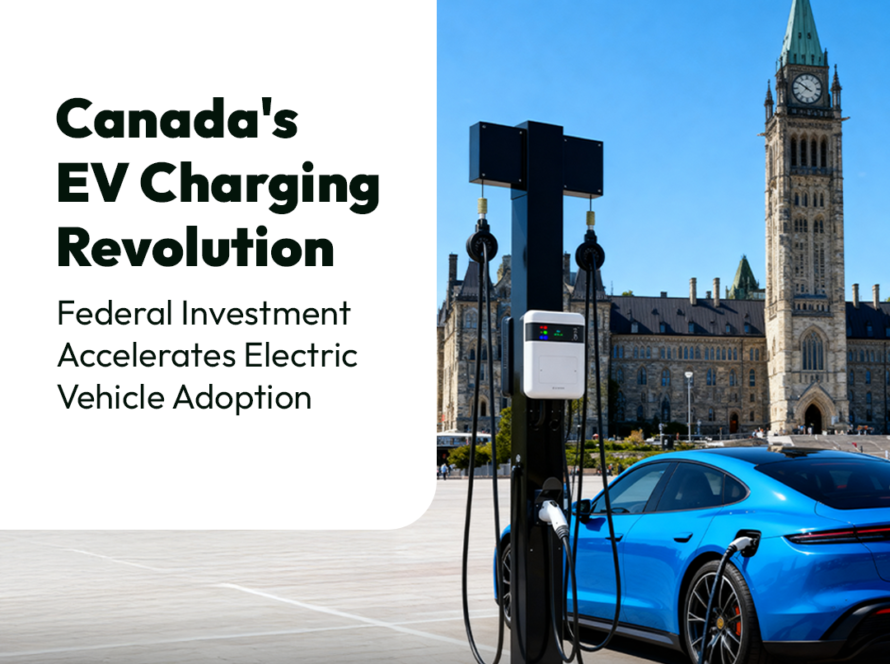
Canada has placed one of the largest bets in its history on electric vehicle infrastructure. Here’s what every business owner, fleet manager, and property developer needs to know — right now.
The Moment Has Arrived
Canada is no longer tiptoeing toward an electric future — it is sprinting. Prime Minister Mark Carney’s sweeping new auto strategy, backed by over $1.5 billion through the Canada Infrastructure Bank, signals a national commitment that businesses, fleet operators, and property developers simply cannot afford to ignore.
This isn’t incremental policy. This is a structural shift in how Canada will move people and goods for the next two decades. And for organisations that act now, the opportunity is enormous.
At Elocity, we work every day at the intersection of EV charging hardware, smart EV charging software, fleet electrification, and infrastructure consulting. We’ve seen the signals building for years. Now the dam has broken — and this article breaks down exactly what it means for you.
What Canada’s New Auto Strategy Actually Says
The federal government’s new strategy is the most comprehensive EV policy Canada has ever produced. Here are the headlines that matter:
- $1.5 billion through the Canada Infrastructure Bank for EV charging and hydrogen refuelling infrastructure nationwide
- A target of 75% EV sales by 2035 and 90% by 2040 — replacing mandatory sales quotas with stricter greenhouse gas emission standards
- An $84 million investment to add 8,000 new EV charging ports to Canada’s existing network of 30,000+
- A $2.3 billion EV Affordability Program offering up to $5,000 off battery electric vehicles and $2,500 off plug-in hybrids — for both individuals and businesses
Key Insight for Businesses The shift from mandatory EV sales quotas to greenhouse gas emission standards is significant. It puts the accountability on fleets and organisations — not just automakers. If your fleet runs on gasoline in 2030, your carbon footprint will cost you. [3] |
Canada EV Incentives 2026: Complete Summary
The following table consolidates all major federal and provincial EV incentives available in 2026. Incentives can be stacked in many provinces, with combined savings exceeding $10,000 per vehicle in some cases.
| Program | Vehicle Type | Incentive (2026) | Incentive (2030) | Who Qualifies |
| Federal EV Rebate (iZEV) | Battery EV (BEV) | $5,000 | $2,000 | Individuals & businesses |
| Federal EV Rebate (iZEV) | Plug-in Hybrid (PHEV) | $2,500 | $1,000 | Individuals & businesses |
| Quebec Roulez vert | BEV | Up to $7,000 | TBD | QC residents & businesses |
| Ontario EV Incentive | BEV / PHEV | Up to $5,000 | TBD | ON residents & businesses |
| BC Clean Energy Vehicle | BEV | Up to $4,000 | TBD | BC residents |
| Canada Infrastructure Bank | Fleet / Infrastructure | Low-rate financing | Ongoing | Businesses & developers |
Note: Provincial incentive programs are subject to change. Source: Osler legal analysis on 2026 auto strategy. Contact Elocity’s team to verify current stacking eligibility for your province and vehicle mix.
Maximum Incentive Stacking Window Acting in 2026 means capturing the full federal benefit before the phase-down begins. Federal EV rebates step down each year, reaching $2,000 for BEVs and $1,000 for PHEVs by 2030. The window for maximum incentive stacking is right now. |
What This Means for Fleet Managers & Businesses
If you manage a fleet — whether it’s 5 vehicles or 500 — Canada’s new EV policy landscape changes your planning horizon dramatically.
The Rebate Window Is Open — But Won’t Stay Open Forever
The return of federal EV rebates (up to $5,000 per BEV, $2,500 per PHEV) available to businesses is a direct financial incentive to electrify now. According to Osler’s legal analysis, incentives will scale back each year, decreasing to $2,000 for EVs and $1,000 for PHEVs by 2030. Combined with provincial incentives in Quebec and Ontario, the total savings per vehicle can exceed $10,000 in some cases.
Workplace EV Charging Is Now a Business Necessity
Workplace EV charging is no longer a perk — it’s a recruitment and retention tool. As EV adoption surges among employees and company vehicle fleets alike, businesses that install on-site Level 2 EV chargers and DC fast charging today will have lower operating costs, better driver experience, and stronger ESG credentials than competitors who wait.
On-site Level 2 and DC fast charging for fleets is now fundable through federal and provincial programs. Businesses that rely solely on public charging for fleet vehicles are not operating a sustainable strategy.
Charging Infrastructure Is No Longer a Barrier — It’s a Competitive Advantage
According to a February 2026 industry report by Paren, Canada’s DC fast-charging network grew by 28% in 2025 alone — nearly 1,925 new ports — bringing the national total to over 8,804 ports. For fleet operators, the public charging gaps that once made EV adoption impractical are rapidly closing.
Elocity Tip for Fleet Managers Elocity’s infrastructure consulting team can identify every dollar available to your organisation and design the optimal workplace EV charging setup for your vehicle mix and usage patterns. On-site charging can pay for itself through fuel savings and government rebates within 2–3 years. |
What This Means for Real Estate & Property Developers
EV charging is no longer an amenity — it is an expectation. In 2026, properties without EV charging infrastructure are increasingly uncompetitive in both residential and commercial markets.
Residential: EV Charging for Apartments & Condos Is Now Essential
With $5,000 federal EV rebates back on the table, the number of Canadians buying EVs in 2026 will surge. EV charging for apartments, condos, and multi-unit residential buildings is now a top-of-list consideration for new tenants. New residents will arrive at your building with an EV — and if there’s no charging, they’ll look elsewhere. In major urban markets, EV charging readiness is already appearing in listing descriptions as a key selling point.
Commercial: Your Tenants’ Employees & Customers Need Workplace EV Charging
Office parks, retail centres, and mixed-use developments that offer EV charging attract higher-quality tenants and command stronger lease rates. With Canada targeting 75% EV sales by 2035, the volume of EV drivers visiting commercial properties will double, then triple, over the next decade. Commercial EV charging stations are quickly becoming table stakes for any competitive property.
The Smart Developer Installs Charging-Ready Infrastructure Now
The cost of retrofitting a parking garage for EV charging after construction is 3–5x higher than building it in from the start. Smart developers are installing conduit, panels, and charging-ready electrical capacity today — even if they only activate a portion of the chargers immediately.
According to Natural Resources Canada’s EV infrastructure report, Canada will need to install tens of thousands of public ports annually between 2025 and 2040 to meet EV adoption targets — creating an enormous ongoing demand for EV-ready buildings.
Elocity Tip for Property Developers Elocity’s smart EV charging software allows property managers to monetise their charging infrastructure — charging tenants and visitors per kWh while managing load to avoid demand charge spikes. Your charging network can be a revenue line, not just a cost. |
What This Means for Government & Policy Stakeholders
Canada’s new auto strategy is ambitious — but execution is everything. There are critical gaps that government bodies and municipalities must address to ensure the national vision becomes national reality.
The Urban-Rural Divide Must Be Closed
According to data reported by Construction Connect Canada, Ontario and Quebec currently hold 67% of all charging ports in Canada. British Columbia accounts for another 20%. Alberta sits at just 5%. Rural and northern communities — including Indigenous territories — are dramatically underserved.
New federal funding targeting Yukon, the Northwest Territories, and Indigenous-led organisations is an encouraging start. But equitable EV adoption requires sustained, targeted investment in communities where public charging infrastructure is non-existent today.
Smart Charging Standards and EV Load Management Must Be Set Now
BC Hydro’s April 2026 rate adjustments — adding roughly $0.84 more per session for an average passenger car — and the rollout of NACS (North American Charging Standard) connectors signal a maturing public charging market. Government bodies must establish clear interoperability standards, pricing transparency requirements, and smart EV charging load management frameworks before the network scales further.
Elocity works directly with municipalities and utilities to deploy smart charging infrastructure that manages grid load, integrates with renewable energy sources, and provides transparent data to both operators and drivers.
The Elocity Perspective: Why 2026 Is the Decisive Year
We have been building EV charging infrastructure in Canada for years. We have watched the policy environment evolve, the technology mature, and the market shift. And we can say with conviction: 2026 is the year the transition becomes irreversible.
The infrastructure investment is committed. The rebates are live. The fast-charging network is hitting critical mass. The EV sales targets are locked in. Every month that passes without an EV strategy for your fleet, your property, or your municipality is a month of missed savings, missed incentives, and missed competitive advantage.
The question is no longer whether Canada goes electric. The question is whether your organisation leads that transition — or gets dragged into it.
Ready to Lead the Transition? Elocity offers end-to-end EV charging solutions: hardware, smart EV charging software, fleet electrification planning, workplace EV charging installation, and infrastructure consulting. Talk to our team today and find out how Canada’s new EV strategy creates a direct opportunity for your organisation. Contact Elocity: www.elocitytech.com | connect@elocitytech.com |
Frequently Asked Questions: Canada EV Charging 2026
This FAQ section is designed to answer the most common questions from businesses, fleet managers, and property developers navigating Canada’s 2026 EV landscape.
How much is the Canada EV rebate in 2026?
In 2026, the federal government offers up to $5,000 off battery electric vehicles (BEVs) and $2,500 off plug-in hybrid electric vehicles (PHEVs) through the iZEV program. These rebates are available to both individuals and businesses. Provincial top-ups can bring total savings over $10,000 in Quebec and Ontario. Incentives phase down annually, reaching $2,000 and $1,000 respectively by 2030.
Can businesses claim EV charging incentives in Canada?
Yes. Both the federal iZEV vehicle rebate and federal/provincial charging infrastructure grants are available to businesses, fleet operators, and property developers. The Canada Infrastructure Bank also provides low-rate financing for large-scale EV charging infrastructure projects. Elocity’s consulting team specialises in identifying and stacking every available incentive for organisations.
What is the best EV charging solution for a commercial property?
For commercial properties, the optimal solution typically combines Level 2 EV chargers for tenants and employees with a small number of DC fast charging stations for visitor or customer use. Smart EV charging software (like Elocity’s platform) enables per-kWh billing, load management to avoid demand charge spikes, and remote monitoring — turning the charging network into a revenue line rather than a cost centre.
What is EV charging load management and why does it matter?
EV charging load management is software that intelligently controls when and how fast vehicles charge in order to stay within a building’s electrical capacity limits. Without it, multiple vehicles charging simultaneously can trigger demand charge spikes on your utility bill — adding thousands of dollars per month in unnecessary costs. Smart charging load management is essential for any property or fleet with more than a handful of charging stations.
What is the NACS connector standard in Canada?
NACS (North American Charging Standard) is the charging connector originally developed by Tesla and now adopted as the industry standard across North America. In 2026, Canadian charging networks are rolling out NACS connectors alongside CCS (Combined Charging System) adapters. Most new EVs sold in Canada will be NACS-compatible. Building NACS-ready infrastructure today future-proofs your investment.
How does EV charging for apartments and condos work?
EV charging for multi-unit residential buildings (apartments, condos, townhouse complexes) typically involves installing Level 2 charging stations in parking stalls or a shared charging area. Smart EV charging software handles billing per unit, load balancing across multiple chargers, and reporting. Many provinces offer specific funding for multi-unit residential EV charging installations. Elocity has deployed charging solutions across major Canadian cities for exactly this building type.
What provinces have the best EV incentives in Canada in 2026?
Quebec and Ontario offer the most generous combined incentives when stacked with federal rebates. Quebec’s Roulez vert program adds up to $7,000 on top of the federal rebate, while Ontario offers an additional $5,000. British Columbia provides up to $4,000 through its CEV program. Alberta and the Prairie provinces currently have more limited provincial programs, though federal incentives still apply nationwide.