


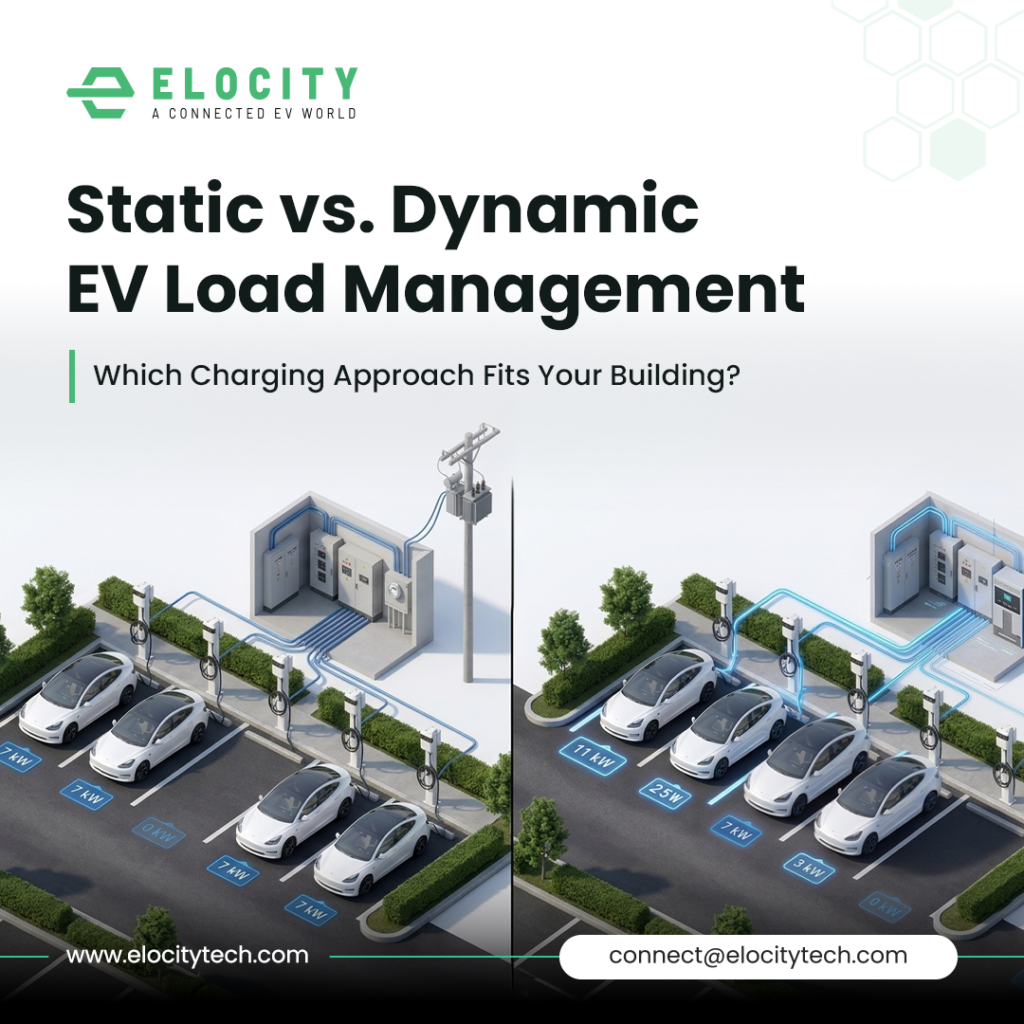
Which EV Charging Approach is Right for Your Building?
Introduction
The single most common reason a condo board, property manager, or commercial building owner hesitates on EV charging is the assumption that adding chargers means upgrading the electrical panel. In many buildings, that assumption is wrong — and the technology that makes it wrong is called EV load management. Load management allows a building to distribute available electrical capacity across multiple EV chargers safely, efficiently, and intelligently, helping avoid unnecessary infrastructure upgrades while supporting growing EV adoption.
There are three main approaches to EV load management: static, rotational, and dynamic. Each solves the same core problem — limited electrical capacity — but they do it in very different ways. The right choice depends on your building size, charging behaviour, available electrical infrastructure, billing needs, and long-term EV adoption plans.
This guide explains how each approach works, where each one fits, and why dynamic load management is usually the best choice for large multi-unit residential, commercial, and fleet deployments.
Why EV Load Management Exists
Most residential and commercial buildings were designed before EV charging became a common requirement. Their electrical systems were sized for lighting, HVAC, elevators, appliances, common areas, and other building loads — not dozens or hundreds of vehicles charging at the same time.
A single Level 2 EV charger can draw around 7.2 kW. If every resident or driver charged at full power at the same time, most buildings would exceed their available electrical capacity very quickly. Traditionally, the solution would be to upgrade the electrical panel or service capacity, which can be costly, time-consuming, and disruptive.
EV load management solves this by controlling how much power each charger receives. Instead of allowing all chargers to draw maximum power at once, the system distributes available capacity across active charging sessions. This helps prevent overloads, reduce peak demand, and make EV charging possible in buildings where electrical capacity is limited.
For broader governance, funding, and rollout planning, read Elocity’s complete guide to EV charging in Canadian condo buildings.
What Is Static Load Management?
Static load management assigns a fixed maximum power allocation to each EV charging port. Every charger receives an equal share of the available electrical capacity, regardless of how many vehicles are actively charging.
For example, if a building has 48 amps available for four chargers, static load management may divide that capacity equally so each charger receives 12 amps. This allocation stays the same whether one vehicle is plugged in or all four are charging.
Static load management is simple and cost-effective. It does not require advanced real-time monitoring or sophisticated software intelligence. Once the allocation is configured, each charger follows the same power limit.
The main advantage is simplicity. It is easy to install, easy to understand, and predictable for drivers because charging speed remains consistent. For small buildings with only a few chargers, this may be enough.
However, static load management becomes inefficient as deployments grow. If only one EV is charging, it still receives only its fixed share, while unused capacity from other idle ports is wasted. As more chargers are added, the fixed allocation per charger becomes smaller, which can result in very slow charging speeds.
Static load management also cannot respond to real-time building demand. If the building’s HVAC system, elevator load, or other equipment suddenly increases demand, the static system does not automatically adjust EV charging to compensate.
Best fit: Static load management is best for small deployments, typically 2–10 chargers, where EV demand is low, predictable, and unlikely to scale significantly.
What Is Rotational Load Management?
Rotational load management, also called time-shared load management, gives each EV charger a full-power charging slot in sequence, rotating charging priority through connected vehicles on a scheduled cycle.
Instead of giving every charger a fixed small allocation, rotational management allows one charger or a group of chargers to receive higher power for a set period. After that time slot ends, the system moves to the next charger or group.
For example, in an overnight residential setting, each EV may receive a 30- to 60-minute charging window before the system rotates to the next vehicle. Over several hours, every connected vehicle receives charging time.
This approach can be more efficient than static load management because each vehicle receives stronger charging power during its turn. It works especially well in residential buildings where cars are parked overnight for six to ten hours.
Rotational management typically requires networked chargers and scheduling software. OCPP-connected chargers allow the platform to start, pause, or adjust charging sessions remotely.
The biggest limitation is driver predictability. A driver’s charging speed depends on where their vehicle sits in the rotation queue. If many vehicles are plugged in, the wait time before receiving power can become long.
Rotational management also does not fully optimize for real-time building demand. If the building experiences a sudden peak load event, the system may not react quickly enough unless additional controls are in place.
As deployments grow beyond 20–30 ports, rotational cycles can become too long and less practical.
Best fit: Rotational load management is suitable for mid-size residential buildings with around 10–30 chargers and mostly overnight charging behaviour. It can also work as a transitional approach for buildings moving from basic load sharing toward dynamic load management.
What Is Dynamic Load Management?
Dynamic load management continuously monitors a building’s total electrical demand in real time and adjusts each EV charger’s power allocation accordingly. It redistributes unused capacity from idle ports to active sessions and automatically reduces charging power during building demand peaks.
This is the most advanced and scalable form of EV load management.
Dynamic load management uses real-time data from the building’s electrical system, active EV charging sessions, and available circuit headroom. The software constantly calculates how much power can safely be delivered to each charger without exceeding the building’s electrical limits.
If only a few vehicles are plugged in, they can receive more available power. When more vehicles connect, the system redistributes power intelligently. If one vehicle finishes charging or disconnects, its unused capacity is immediately made available to others.
If building demand suddenly increases — for example, because of HVAC startup, elevator use, or other peak loads — dynamic load management automatically reduces EV charging power to prevent overload. Once the building load drops, the system restores charging power.
Elocity’s HIEV CPMS implements dynamic load management and supports 1:4 dynamic load management. This means one electrical circuit can safely serve up to four EV charging ports through intelligent power redistribution. This can achieve up to 75% peak demand reduction compared to unmanaged charging.
For a 48-port deployment, this means the building may be able to support the charger fleet using the equivalent electrical infrastructure of a 12-port unmanaged installation.
The advantages are significant. Dynamic load management maximizes available electrical capacity, avoids wasted power, helps reduce or avoid panel upgrades, supports large-scale deployments, and enables advanced features such as utility demand response, accurate kWh billing, and future integration with solar, battery storage, and V2G systems.
For accurate kWh-based billing in Canada, EV charging deployments should consider Measurement Canada requirements and certified sub-metering for defensible cost recovery.
Dynamic load management does require more sophisticated infrastructure than static or rotational approaches. It needs OCPP-compliant chargers, a cloud-based platform, and real-time energy monitoring. For very small deployments of only two to five chargers, static load management may still be more cost-effective.
Best fit: Dynamic load management is best for large multi-unit residential buildings, commercial properties, fleet depots, mixed-use developments, and utility-managed programs — especially where the building needs to scale without major electrical upgrades.
Static vs. Rotational vs. Dynamic Load Management: Side-by-Side Comparison
| Criteria | Static Load Management | Rotational Load Management | Dynamic Load Management |
| How it works | Fixed power cap per charger. Each port always gets an equal share of available capacity. | Chargers take turns at full power, rotating through connected vehicles. | Real-time software adjusts each charger’s power based on building load, active sessions, and available capacity. |
| Infrastructure requirement | Minimal. No active monitoring needed. | Low. Requires OCPP-connected chargers and scheduling software. | Moderate. Requires OCPP-connected chargers, cloud platform, and real-time building energy data. |
| Charging speed for drivers | Predictable but slower as more chargers are added. | Faster during each vehicle’s turn but less predictable overall. | Fastest overall because unused capacity is redistributed in real time. |
| Scalability | Limited. Fixed slices become smaller as more ports are added. | Moderate. Works for around 10–30 ports. | Strong. Built for large-scale deployments from 50 to 1,200+ ports. |
| Best for | Small buildings with 2–10 chargers. | Mid-size buildings with 10–30 chargers and overnight charging. | Large MURBs, commercial buildings, fleets, and utility programs. |
| Avoids panel upgrades? | Partially. | Partially. | Yes, in most cases, through intelligent peak demand reduction. |
| Billing support | Limited unless accurate metering is available. | Depends on charger sub-metering. | Supports kWh-based billing with certified sub-metering. |
| Elocity HIEV CPMS support | Supported for very small deployments. | Supported as a transitional approach. | Primary recommendation for scale, accuracy, and grid integration. |
Which Approach Is Right for Your Building?
For a small building with only two to eight chargers and simple overnight charging needs, static load management may be sufficient. It is low-cost, easy to manage, and adequate when EV demand is predictable.
For a condo or strata building with 10–25 chargers and mostly overnight charging, rotational load management can provide a balance between cost and performance. It gives drivers access to stronger charging power during scheduled windows without requiring the full complexity of dynamic management.
For any building planning more than 25 chargers, dynamic load management is usually the right choice. It is the only approach that can scale without major infrastructure compromise, especially when usage patterns vary across daytime, evening, and overnight periods.
For large MURBs, commercial buildings, mixed-use properties, fleet depots, utility-managed demand response programs, and buildings with tight electrical capacity, dynamic load management becomes essential. These sites require real-time control, accurate power distribution, peak demand reduction, and long-term scalability.
Dynamic management is also the preferred approach for buildings planning solar PV, battery storage, or V2G integration because these systems require real-time coordination between energy generation, storage, grid demand, and EV charging.
Decision Matrix
| Your situation | Recommended approach |
| 2–8 chargers, new build, simple overnight residential charging | Static — low complexity, low cost, adequate for the scale |
| 10–25 chargers, condo/strata, overnight-dominant charging window | Rotational — balances cost and performance for this profile |
| 25+ chargers, multi-unit residential, mixed day/evening usage | Dynamic — only approach that scales without a panel upgrade |
| 50–500+ chargers, large MUR/commercial/mixed-use property | Dynamic — mandatory at this scale; HIEV CPMS is purpose-built for this |
| Fleet depot: electric buses, delivery vehicles, corporate pool | Dynamic — demand charge management and shift-start guarantees require dynamic scheduling |
| Utility-managed demand response program | Dynamic — real-time control is required; static and rotational cannot respond effectively |
| Building with solar PV or battery storage | Dynamic — coordinates EV charging, solar, and storage in real time |
| Building with tight electrical capacity / no budget for panel upgrade | Dynamic — 1:4 dynamic load management can reduce peak demand and make panel upgrades avoidable in most buildings |
| Government grant application | Dynamic — smart, network-managed charging is increasingly important for funding and program eligibility |
Not sure which approach fits your building? Elocity provides site assessments for property managers and boards evaluating EV charging. A site assessment can cover electrical capacity, charger layout, load management recommendation, and funding eligibility. Request a site assessment.
Advanced Dynamic Load Management: Solar, Storage, and V2G
Dynamic load management is not only about EV charging. It is also the foundation for smarter building energy management.
As buildings add solar panels, battery storage, and bidirectional EV charging, they need a platform that can coordinate multiple energy resources in real time. A static or rotational system cannot make intelligent decisions based on solar generation, battery state, grid demand, and active EV charging sessions.
Elocity’s HIEV: Nano controller is designed to extend dynamic load management to coordinate solar PV generation, on-site battery storage, and V2G charging through the HIEV platform. When solar generation is high, EV charging can be increased to absorb surplus renewable energy. During grid demand events, the system can reduce EV load or use stored energy to support grid stability.
For buildings planning future energy upgrades, it is important to design EV charging infrastructure with dynamic load management from the beginning. Retrofitting later can be more expensive and complex than building for scalability upfront.
Proof Points at Scale
Dynamic load management is especially valuable when deployments move from a few chargers to hundreds or more. Learn more about Elocity’s large-scale project experience through these case studies:
- Richmond Centre, BC — 1,200+ charger case study
- Tridel — 545 chargers across 12 Ontario condo buildings
Frequently Asked Questions
1. What is dynamic EV load management?
Dynamic EV load management is software that continuously monitors a building’s electrical demand and automatically adjusts the power delivered to each EV charger in real time. It redistributes unused capacity from idle chargers to active sessions and reduces charging power during building demand peaks. Elocity’s HIEV CPMS supports dynamic load management for deployments ranging from small installations to large-scale charging networks.
2. What is the difference between static and dynamic EV load management?
Static load management gives each charger a fixed power cap, regardless of how many vehicles are charging or how much power the building is using. Dynamic load management adjusts charging power in real time based on actual building demand, available capacity, and active charging sessions. Dynamic management is much more efficient for larger deployments.
3. Can EV chargers be added without upgrading the electrical panel?
Yes, in many buildings. Dynamic load management helps avoid panel upgrades by preventing all chargers from drawing maximum power at the same time. Elocity’s HIEV CPMS 1:4 dynamic load management can achieve up to 75% peak demand reduction, allowing buildings to support more chargers on existing infrastructure.
4. What is 1:4 dynamic load management?
1:4 dynamic load management means one electrical circuit can safely serve up to four EV charging ports through intelligent power redistribution. For example, a building installing 48 charging ports may only need the equivalent electrical infrastructure of a 12-port unmanaged installation, depending on site conditions and design.
5. Which EV load management approach is best for a condo building?
For most condo and strata buildings planning more than 20–25 EV chargers, dynamic load management is the best choice. It scales more efficiently, helps avoid panel upgrades, supports accurate kWh billing, and enables future participation in utility demand response programs. Static or rotational management may be suitable for very small deployments with limited EV demand.
6. Does dynamic EV load management work with solar panels and battery storage?
Yes. Dynamic load management can coordinate EV charging with solar PV and battery storage by adjusting charging based on generation, demand, and available stored energy. This makes it suitable for buildings planning renewable energy or grid-interactive infrastructure.
7. Does HIEV CPMS support all three types of EV load management?
Yes. HIEV CPMS by Elocity supports static, rotational, and dynamic load management on one OCPP-compliant cloud platform. This allows property managers to start with a simpler approach and move toward dynamic management as EV adoption grows, without replacing the entire system.
Final Thoughts
Static, rotational, and dynamic load management are not interchangeable. They solve the same problem at different levels of sophistication, efficiency, and scale.
Static load management is simple and cost-effective for very small deployments. Rotational load management can work for mid-size buildings with predictable overnight charging. But for buildings planning more than 25 chargers, or any deployment that needs to avoid panel upgrades, support accurate billing, respond to utility demand, or scale over time, dynamic load management is the strongest long-term choice.
HIEV CPMS by Elocity brings static, rotational, and dynamic load management into one platform, with dynamic load management as the primary recommendation for scalable, future-ready EV charging deployments. For multi-unit residential buildings, commercial properties, fleets, and utility-managed programs, dynamic load management is not just a technical feature — it is the foundation for practical, cost-effective EV charging at scale.
Calls to Action
- Request a free site assessment for your building
- Explore HIEV CPMS load management features
- Read the complete guide to EV charging in Canadian condo buildings
- Explore HIEV Level 2 chargers with Measurement Canada metering
Contact
Elocity Technologies Inc.
23A, 156 Duncan Mill Rd, Toronto, ON M3B 3N2
Email: connect@elocitytech.com
Website: www.elocitytech.com
Phone: +1 (416) 384-1919