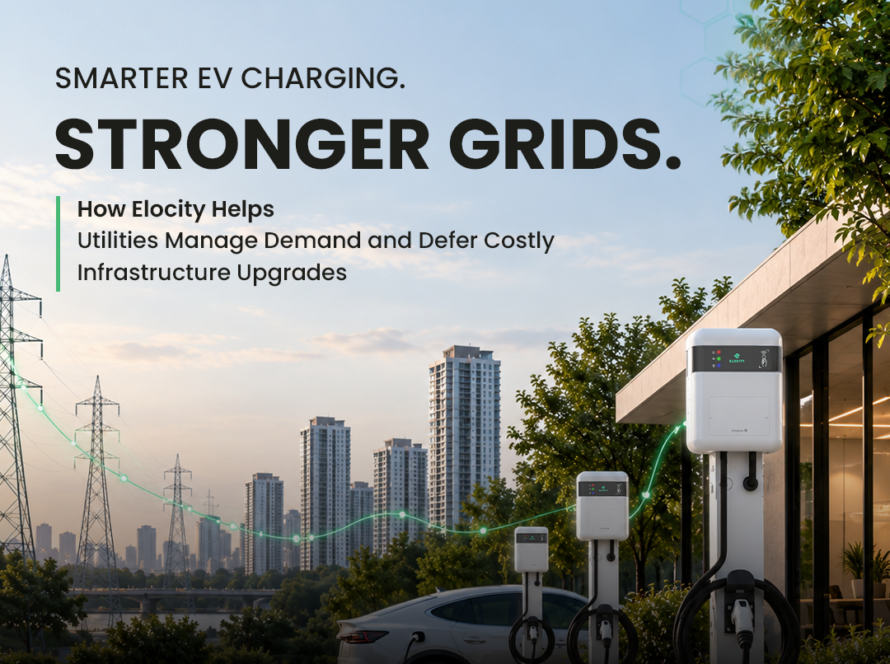
Building-level EV load management is software and control infrastructure that distributes a building’s available electrical capacity across connected EV chargers, keeping total charging load within the site limit. For property managers in condominiums, strata corporations and multi-unit residential buildings (MURBs), it is the primary way to add EV charging without an automatic service upgrade.
Key Takeaways
- There are three main approaches: static (fixed power per port), rotational (scheduled turns) and dynamic (real-time reallocation against building demand).
- Dynamic load management generally suits large MURBs, workplaces and fleet depots where charger counts and building loads vary.
- Ontario condominium corporations generally have 60 days to respond to a complete owner EV charging application.
- BC strata corporations with five or more lots must obtain an electrical planning report by December 31, 2026 or December 31, 2028, depending on region.
- Confirm OCPP certification, Measurement Canada metering requirements and rebate pre-approval before committing to equipment or construction.
Property managers are increasingly the first people condominium boards, strata councils and building owners turn to when residents ask for EV charging. The central question is no longer whether to install chargers, but how to add them without overloading the electrical system, creating avoidable capital costs or causing billing disputes. Building-level EV load management addresses all three by controlling how available power is distributed across connected chargers.
This guide explains the three main load management approaches, the Ontario and British Columbia regulatory context, the questions boards commonly ask, and the criteria property managers should use when evaluating an EV charging platform.
Why Building-Level EV Load Management Matters
Without coordinated control, multiple EVs may try to charge at the same time. That can push circuits or the building service beyond planned limits, increase peak demand and make a costly electrical upgrade appear unavoidable. A managed system keeps charging within defined electrical limits and shares available capacity across drivers.
- Electrical capacity: Load management determines how many charging ports a building can support safely using available infrastructure.
- Fair billing: Session-level metering and user accounts help allocate charging costs to the people using the service.
- Operational accountability: Remote monitoring, alerts and diagnostics give the property manager one operating view instead of separate hardware, billing and support silos.
- Long-term scalability: A networked design lets the building add ports and revise charging rules as demand grows.
Static vs. Rotational vs. Dynamic EV Load Management
Static Load Management
Static load management assigns a fixed maximum power limit to each charging port. Every charger receives the same allocation regardless of how many vehicles are connected, so the approach is simple and predictable but may leave available capacity unused when ports are idle. It is generally best suited to small installations with modest growth expectations.
Rotational Load Management
Rotational load management gives connected chargers scheduled turns at higher power. This can work well in residential buildings where vehicles remain parked overnight, but charging time becomes less predictable as the queue grows. It is typically a transitional option for mid-sized deployments.
Dynamic Load Management
Dynamic load management monitors building demand and active charging sessions in real time, then adjusts power to each charger without exceeding the site limit. When one vehicle finishes or disconnects, its unused capacity can be reassigned immediately. If HVAC, elevators or other building loads rise, EV charging can be reduced temporarily and restored when capacity becomes available.
Elocity’s HIEV CPMS supports static, rotational and dynamic load management on one OCPP-based platform. Its 1:4 dynamic configuration can allow one circuit to serve up to four ports through intelligent power redistribution, subject to site conditions and electrical design.
EV Charging Rules for Ontario Condos and BC Stratas
Ontario Condominiums
The Condominium Authority of Ontario EV charging guide outlines separate processes for installations initiated by a corporation and applications submitted by an owner. For a corporation-led installation, an owner vote may not be required when the estimated cost is below 10 percent of annual budgeted common expenses or when the board reasonably believes owners will not consider the change to have a material negative effect on their use or enjoyment. The corporation must still follow the prescribed notice process.
When an owner submits a complete EV charging application, the corporation generally has 60 days to respond unless another period is agreed to in writing. Property managers should log the submission date, required documents, board decision and response deadline for every application.
British Columbia Strata Corporations
British Columbia requires strata corporations with five or more lots to obtain an electrical planning report by December 31, 2026 in Metro Vancouver, the Fraser Valley and the Capital Regional District, with specified island exceptions. The deadline is December 31, 2028 for other areas of the province. The report must address current capacity, existing and future demand, peak load and available headroom.
For property managers, the electrical planning report should be treated as the foundation for EV charging decisions. It provides the data needed to compare unmanaged charging, load-managed designs and infrastructure upgrades. Requirements can change, so confirm current rules and obtain legal or engineering advice for the specific property.
How HIEV CPMS Manages EV Load in Multi-Unit Buildings
Elocity’s HIEV CPMS combines charger monitoring, load management, tariffs, payments, alerts, reporting and driver access within one operating platform. For property managers, this creates a single view of energy use, charger status and billing activity across the property.
- Dynamic power control: Charging can be adjusted against building demand, circuit capacity and panel limits.
- Hardware flexibility: HIEV CPMS supports more than 50 charger makes and models through OCPP, helping reduce dependence on a single hardware supplier.
- Accurate metering: Elocity Level 2 configurations are available with built-in Measurement Canada-certified metering for energy-based billing.
- Remote operations: Monitoring, alerts and remote resets can resolve many operational issues without an immediate site visit.
- Reporting and security: The platform supports operational and program reporting, Canadian data residency and ISO/IEC 27001-aligned information security controls.
At Richmond Centre in British Columbia, Elocity technology supports 1,212 smart chargers in one multi-residential deployment. The project illustrates why coordinated power management and a scalable operating platform matter when charging expands from a few stalls to an entire parkade.
Which EV Load Management Approach Fits Your Property?
The following framework is a starting point. The final design should be based on an electrical capacity assessment, parking layout, resident demand, operating model and expected charger density.
| Property type | Typical challenge | Recommended approach | Priority action |
|---|---|---|---|
| Small condo or townhouse | A few dedicated stalls and predictable overnight use | Static or basic sharing | Set building standards and confirm circuit capacity |
| Mid-sized condo or strata | Growing demand with limited panel headroom | Rotational or dynamic | Complete electrical planning and design for expansion |
| Large high-rise MURB | Many ports and variable building demand | Dynamic | Model building peaks and phase the rollout |
| Commercial workplace | Arrival peaks, daytime charging and demand charges | Dynamic with schedules | Set demand caps and charging priorities |
| Retail or mixed-use site | High turnover, mixed users and paid sessions | Dynamic with billing | Define public, tenant and fleet tariffs |
| Fleet or logistics depot | Shift readiness and concentrated overnight load | Dynamic demand-capped scheduling | Plan around route and departure requirements |
How to Answer Common Condo Board Questions on EV Charging
| Board question | Practical response |
|---|---|
| Can our electrical system support EV charging? | Commission a capacity assessment and compare unmanaged load with static, rotational and dynamic designs before assuming a service upgrade is required. |
| Will non-EV owners subsidize charging? | Use individual accounts and approved metering so electricity and service fees can be assigned to EV users under the chosen cost-recovery model. |
| Do owners need to vote? | The answer depends on the province, project scope, cost and approval path. Use the applicable authority guidance and consult condominium or strata counsel. |
| Is the project too expensive? | Compare phased capital investment, available incentives, user-pay recovery and service-based operating models. Do not include an incentive until eligibility and pre-approval are confirmed. |
| What happens when a charger fails? | Require remote diagnostics, escalation procedures, response targets, spare-parts planning and one clearly accountable support contact in the agreement. |
| Will the system become obsolete? | Specify networked OCPP equipment, scalable electrical infrastructure, documented data access and a platform that supports future integrations. |
EV Charging Rebates and Funding for Condos and Stratas
Funding programs can reduce project cost, but their eligibility rules and intake windows change. Property managers should check the current NRCan Zero Emission Vehicle Infrastructure Program page and the relevant provincial or utility program before presenting a net cost to the board.
In British Columbia, the BC Hydro EV charger rebates for apartments, condos and townhomes support eligible EV-ready planning, infrastructure and chargers while funding lasts. Pre-approval is required before starting or committing to eligible work. A building may also need an EV Ready plan, opportunity assessment or electrical planning report, depending on the rebate path.
Do not begin construction, purchase chargers or assume incentives can be stacked until the program administrator confirms eligibility. Keep approval letters, invoices, network reports and commissioning records in one project file for the final claim.
How to Future-Proof Building EV Charging Infrastructure
- Use open connectivity: Ask for documented OCPP certification rather than a general statement that equipment is “compatible.” The Open Charge Alliance certification program provides the independent framework.
- Plan conduit and communications early: Future cable pathways are usually less disruptive to install during the first phase than after parking areas are finished.
- Confirm metering requirements: Review Measurement Canada guidance for EV charging stations before adopting energy-based billing.
- Specify data and security terms: Document data ownership, residency, export rights, breach response and the scope of the provider’s ISO/IEC 27001 certification.
- Prepare for distributed energy: Buildings considering solar, battery storage or bidirectional charging should select platforms that can coordinate energy assets. ISO 15118-20 is an important communication standard for future vehicle-to-grid services.
EV Charging Vendor Evaluation Checklist for Property Managers
| Evaluation criterion | Question to ask |
|---|---|
| Independent OCPP certification | Which OCPP version is certified, and can you provide the certificate? |
| Load management | How does the system respond to real-time building demand, and what site data is required? |
| Metering and billing | What meter approval applies to the proposed charger and billing model? |
| Hardware flexibility | Which charger makes and models are supported, and how is interoperability tested? |
| Data and cybersecurity | Where is data hosted, who owns it, and what is covered by ISO/IEC 27001 certification? |
| Support accountability | Who owns hardware, software and billing incidents, and what response targets are contractual? |
| Comparable references | Can you provide references from buildings with similar parking, electrical and governance constraints? |
Elocity publishes details of its OCPP 1.6 certification, Measurement Canada metering and ISO/IEC 27001 credentials. Property managers should still request project-specific specifications, support terms and references as part of procurement.
Frequently Asked Questions About Building-Level EV Load Management
What is building-level EV load management?
Building-level EV load management is software and control infrastructure that distributes available electrical power across connected charging stations. It keeps aggregate charging within the building limit while allocating power according to defined rules and real-time conditions.
Does a condo building always need a panel upgrade to add EV chargers?
No. Static, rotational or dynamic load management may allow a building to support charging within existing capacity. An electrical assessment is still required because the result depends on the service, panels, other building loads and planned charger count.
How can EV charging costs be allocated fairly?
Use individual driver accounts, session records and a metering arrangement appropriate to the billing model. For energy-based billing in Canada, confirm the applicable Measurement Canada requirements before deployment.
What is the 60-day rule for Ontario condo applications?
When an owner submits a complete EV charging application, the condominium corporation generally has 60 days to respond unless the parties agree in writing to a different period. Property managers should use the CAO process and templates and obtain legal advice when needed.
Does a BC strata need an electrical planning report?
A BC strata corporation with five or more lots generally must obtain an electrical planning report. The deadline is December 31, 2026 in specified major regional districts and December 31, 2028 in other areas, subject to the rules and exceptions on the provincial guidance page.
What rebates are available for condo or strata EV charging?
Programs vary by location and intake period. Check the current NRCan, provincial and utility pages before budgeting, and obtain written pre-approval before committing to work where the program requires it.
Why does OCPP matter?
OCPP is an open communication protocol between chargers and management platforms. Independent certification helps reduce integration risk and gives the building more flexibility to use supported hardware from different manufacturers.
What is the difference between a hardware-only vendor and a full-stack provider?
A hardware-only vendor may rely on separate providers for networking, billing and service. A full-stack provider can combine equipment, software and support, but the contract should still identify accountability, service levels, data rights and exit terms clearly.
Next Steps for Property Managers
Building-level EV load management is both a technical and property-management decision. Start with an electrical assessment, a clear cost-recovery model and a scalable platform so the board can plan around capacity, lifecycle cost and resident needs.
Explore Elocity solutions for multi-unit residential properties or contact Elocity to discuss a site assessment and load management strategy.
About the Author
Don Huff — Chair of the Advisory Board, Elocity
Don Huff is an experienced environmental strategist, communicator and clean-energy advocate. As Chair of Elocity’s Advisory Board and Founder of ECO Strategy, he brings together policy insight, industry relationships and a passion for creating practical environmental impact.